

Call Anytime
Explore the rich heritage and the vibrant culture of the Edo people.
Eheneden Erediauwa, Omo N’Oba N’Edo Uku’ Akpolokpolo Ewuare II – The 40th Oba of Benin Kingdom
The Edo people, founders of the Benin Kingdom, were originally ruled by kings known as the Ogiso (Kings of the Sky), and referred to their land as Igodomigodo. The first Ogiso, Igodo, was known as a wise and influential ruler. After his passing, his son Ere succeeded him. In the 12th century, a palace conspiracy led to the exile of Crown Prince Ekaladerhan, who was wrongly sentenced to death due to a manipulated oracle message. Instead of executing him, palace messengers spared his life and released him in Ughoton, near Benin. Following the Ogiso’s death, the dynasty came to an end, and the people sought out Ekaladerhan to become king.
Ekaladerhan had settled in Ile-Ife and taken the name Izoduwa (meaning “I have chosen the path of prosperity”). The people of Benin, led by Chief Oliha, sought him out. As he was advanced in age, he sent his grandson Oranmiyan to rule in his stead. Oranmiyan met resistance from Ogiamien Irebor and eventually left, declaring the land “Ile-Ibinu” (Land of Vexation), a name later mispronounced as “Benin” by the Portuguese. Before departing, Oranmiyan installed his son Eweka, born to Erinmwinde, as king. Though initially mute, Eweka spoke after playing with special seeds and announced “Owomika” as his royal name. He became the first Oba in a new dynasty. Oranmiyan later founded the Oyo Empire, where his descendants continued to rule.
Construction and Early Development
The city of Benin emerged by 1000 CE in a forested area ideal for defense and resources. The early walls and moats, known as “Iya,” date back to between the 1st millennium and 15th century. These structures, some stretching up to 16,000 kilometers in total, were built using massive earthworks, showcasing extraordinary engineering by the Edo people.
Agriculture and Settlement
By the 1st century BC, the region was partially agricultural. By 500 AD, farming had become dominant, although hunting and gathering remained important. Iron tools were in use by this time. The region’s rich rainforest provided abundant resources, helping Benin City flourish.
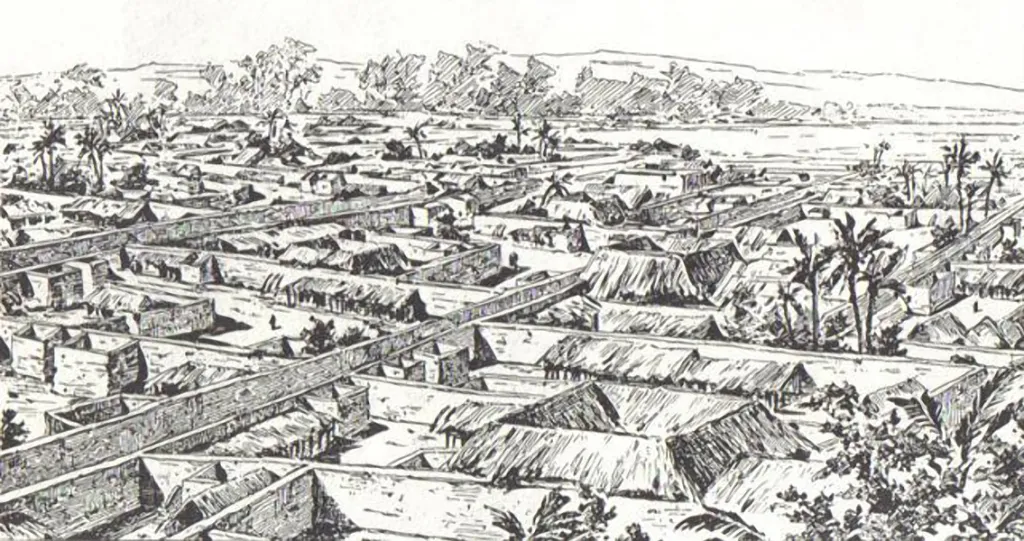
Architectural Marvels
Depictions of Benin from as early as 1668 reveal grand earthworks and fortifications. These walls served not only defensive purposes but also marked the territory of the expanding kingdom. They were described by early explorers such as Duarte Pacheco Pereira and Dierick Ruiters. The scale and sophistication of the city’s layout even featured fractal geometry in its planning.
European Encounters and Trade
The Portuguese first arrived around 1485, establishing trade relations. The Edo traded slaves, ivory, and palm oil in exchange for guns and metals. This relationship introduced new materials and influenced Edo craftsmanship. Despite these changes, the kingdom retained a strong cultural identity and independence until British intervention in the 19th century.
Golden Age and Expansion
Oba Ewuare the Great (1440–1473) transformed Benin into a military and cultural powerhouse. He expanded its territories, built moats and palaces, and initiated architectural projects that would influence the region for centuries. The Oba was regarded as divine, and his role was both spiritual and political.
Benin’s influence extended across present-day Nigeria, including Lagos and parts of the Yoruba region. It became a dominant coastal power, leading to the naming of the Bight of Benin. The kingdom governed various ethnic groups through a system of local enogies appointed by the Oba.
Artistic Excellence
Benin developed a world-renowned tradition of bronze, ivory, and iron artworks. These included life-sized busts, plaques, and ceremonial masks. The most iconic, the FESTAC Mask representing Queen Idia, symbolized Edo royalty and heritage at the 1977 FESTAC cultural festival.
Colonial Era and Legacy
British forces invaded Benin in 1897, destroying many cultural treasures and displacing the royal structure. Despite this, remnants of the ancient walls still exist, and the legacy of Benin’s achievements in governance, architecture, and artistry remains a source of pride.
Today
Benin’s rich history continues to be celebrated by the Edo people and their descendants. The monarchy endures, and its traditions are honored both in Nigeria and the global diaspora.
The Edo Union Netherlands plays an important role in preserving this heritage for future generations.
Here are five notable achievements and creations by the Benin Kingdom, especially under the reigns of its great leaders and craftsmen — which made the Benins famous around the world:
World-renowned artworks made of brass, bronze, and ivory.
Created by highly skilled Edo guilds, especially under the Obas like Oba Ewuare and Oba Esigie.
Includes plaque reliefs, commemorative heads, and royal figures that once adorned the walls of the Oba’s palace.
Looted during the British invasion in 1897, many are now displayed in museums around the world (e.g., British Museum, Berlin Ethnological Museum).
A vast system of moats and earthworks that surrounded Benin City and its districts.
Estimated to stretch over 16,000 km, covering about 6,500 km² of territory.
Recognized by Guinness World Records as one of the largest man-made structures in history (by length and mass).
Benin City was laid out in a geometric fractal pattern, from palace design to residential spaces.
Streets were wide and neatly laid out, with public squares and structured zones.
Ethnomathematicians have since praised this as evidence of advanced African mathematical thinking long before European colonization.
A massive and intricately designed royal complex, the center of governance and culture.
Decorated with bronze plaques, ivory carvings, and sculpted wooden pillars.
Included shrines, throne rooms, courtyards, and galleries, reflecting the wealth and sophistication of the Benin monarchy.
The Benin Kingdom had formal guilds for artists, carvers, blacksmiths, and bronze casters — overseen by royal patronage.
These guilds ensured the preservation of artistic knowledge, strict standards of excellence, and continuity of Edo traditions.
Their works not only celebrated Edo history but also served as royal documentation, long before Western writing systems were introduced.